




25 Sept. 2026 · Axiom Controls
Beyond the Breaker: How Distribution Boards Improve Electrical Safety, Organisation, and Reliability
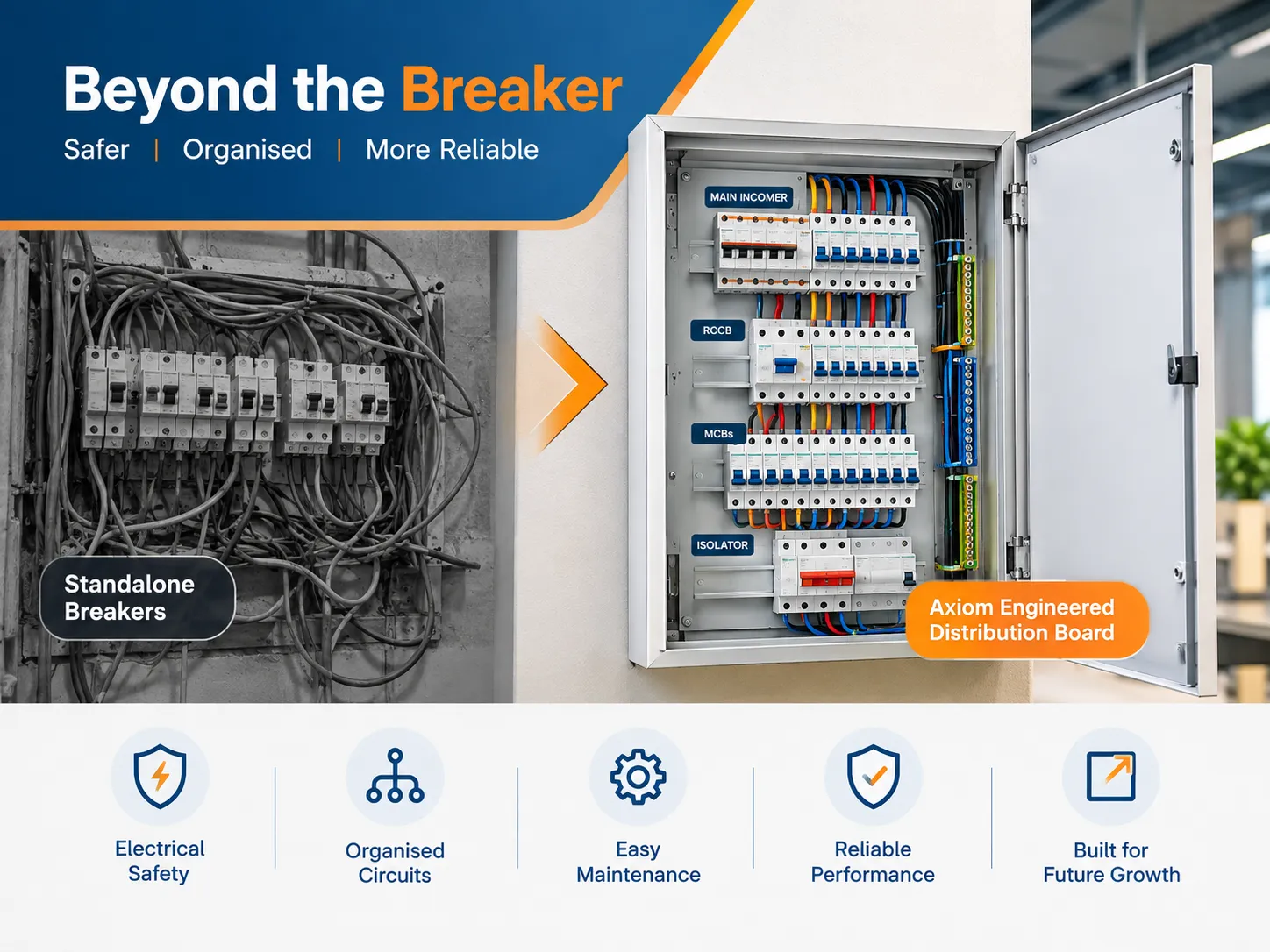
Electrical safety is not determined by a single circuit breaker. It depends on how the entire electrical distribution system is designed, organized, and protected. This is where Distribution Boards (DBs) play a vital role.
A well-designed distribution board brings multiple protection devices together into a structured, centralized system. By coordinating individual breakers inside an engineered enclosure, a DB efficiently distributes power across various circuits while keeping the entire installation manageable, safe, and easy to maintain.
Comparative Analysis: Standalone Breakers vs. Axiom Integrated DBs
| Feature / Criteria | Standalone Circuit Breaker Setup | Axiom Engineered Distribution Board (DB) System |
|---|---|---|
| Protection Integration | Protects individual lines only against localized overloads or short circuits. | Centralizes multi-level protection-combining MCBs, RCCBs, RCBOs, and Isolators in one coordinated unit. |
| Circuit Segregation | High risk of overloaded single-bus lines, tangled cabling, and clutter. | Dedicated circuit segregation for HVAC, lighting, heavy machinery, and general power outlets. |
| Safety & Fault Isolation | A single trip or earth fault can trigger widespread power loss across unrelated areas. | Limits fault impact exclusively to the affected branch via selective tripping and earth leakage protection. |
| Maintenance & Inspection | Tracing loose or unorganized wires leads to extended downtime and safety risks. | Clearly labeled, ergonomic layouts allow rapid fault identification and safer maintenance. |
| Scalability & Enclosure | Difficult to expand without adding external clutter or compromising safety ratings. | Purpose-built for application-specific demands, IP20/IP-rated protection, and future expansion. |
Core Advantages of an Engineered Distribution Board
1. Enhanced Electrical Safety - A distribution board provides a central point where protective devices such as MCBs, RCCBs, RCBOs, and isolators are systematically installed and managed. While standard MCBs focus on overcurrent and short-circuit protection, incorporating Residual Current Circuit Breakers (RCCBs) guards against ground faults and lethal electric shocks. Proper circuit segregation limits fault impact and supports safer overall system operation.
2. Improved Circuit Organisation - Electrical installations quickly become difficult to manage when circuits are unorganized. A properly configured DB separates lighting, general power, HVAC, and industrial machinery into dedicated branch circuits. This logical layout simplifies identification and streamlines troubleshooting.
3. Streamlined Maintenance and Reduced Downtime - When circuits are cleanly arranged and clearly labeled, electricians and facility teams can locate problematic circuits in seconds. Rapid identification reduces unnecessary operational disruptions during inspections, repairs, or future system modifications.
4. System Reliability Through Coordinated Engineering - Overall reliability depends on how protective components interact as a cohesive unit. A correctly selected, high-quality distribution board ensures effective power balancing, reliable breaking capacity, and continuous performance across residential, commercial, and industrial facilities.
5. Designed for Application-Specific Needs - Every building profile carries distinct power demands. Residential complexes, commercial towers, industrial plants, and infrastructure projects require tailored enclosure ratings, load capacities, and protection levels. Choosing a distribution board goes beyond enclosure size or aesthetic appearance - load profiles, accessibility, environmental factors, and room for expansion all matter.